 Mixmonde
Play free
Ratio, Rate & Percent: 5th grade math in Serengeti
Singapore teaches these in Primary 5; in the US they start in grade 6. Unlocked by the teacher.
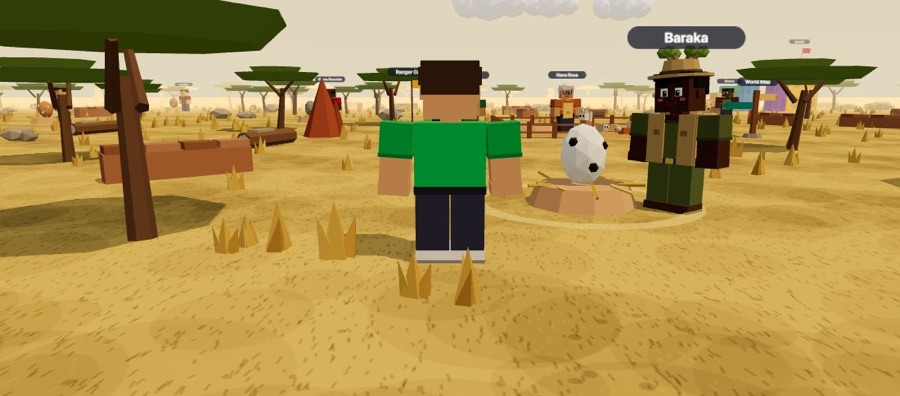
Follow the Great Migration across the endless plains of Tanzania. Characters here greet you with “Habari!” (hello in Kiswahili (it means “What’s the news?”)), and eggs hatch into hybrids of animals like wildebeest, plains zebra, Masai giraffe and ostrich.
What your child practices
Follows Preview of Ratios & Proportional Relationships (6.RP).
Ratio Notation
Write ratios like 2 : 3 and 2 : 3 : 4, find equal ratios and simplify them.
6.RP.A.1
Ratio Word Problems
Use units to solve ratio problems: find one unit first, then the part you need.
6.RP.A.3
Rate
A rate is an amount per unit, like 12 liters per minute. Use it to find totals and times.
6.RP.A.2, 6.RP.A.3
Part of a Whole as a Percent
Percent (%) means "out of 100". 12 out of 40 is 30%.
6.RP.A.3c
Percent of a Quantity
Find 25% of 80, solve two-step percent stories, take a discount, add GST, or work out a year of interest.
6.RP.A.3c
Percents, Fractions and Decimals
Switch between 3/4, 0.75 and 75%: they are three ways to write the same amount.
6.RP.A.3c
Try a problem from Serengeti
Every problem is a short story set in the world. These are real problems from the game. Kids get endless new ones with different numbers.
You count 5 striped hatchlings and 15 spotted hatchlings in your herd of pets.
What is the ratio of striped hatchlings to spotted hatchlings in simplest form?
Show the answer
1 : 3
- Write the ratio in order: 5 : 15.
- Divide both terms by 5: 1 : 3.
The ratio of striped eggs to spotted eggs in your farm’s incubator is 3 : 5.
There are 6 more spotted eggs than striped eggs.
How many spotted eggs are there?
Show the answer
15
- The difference is 5 − 3 = 2 units.
- One unit: 6 ÷ 2 = 3.
- 5 × 3 = 15.
Your hatchling herd drinks 45 liters of water in 9 days.
They drink the same amount each day.
How many liters do they drink per day?
Show the answer
5 L per day
- Rate = total ÷ number of units.
- 45 ÷ 9 = 5.
Common mistakes, and how to help
Every wrong answer in Mixmonde is planned: it points to a named mistake, and the tip after a miss explains it with that problem’s numbers. These are the mistakes this world watches for, grouped the way the grown-ups’ dashboard shows them.
-
Order and direction
The right idea done the wrong way round: taking the smaller digit from the bigger one, dividing backwards, swapping x and y, or flipping more and less.
Mistakes we catch: wrote the ratio in the wrong order and found the rate upside down.
Try at home: For ratios and coordinates, write labels on the numbers (“birds : eggs”, “across, then up”) and check the order matches the question.
-
Ratio and scaling
Adding when the situation multiplies: doubling a recipe by adding 2 to each amount, or taking a percent of the wrong total.
Mistakes we catch: did not fully simplify, compared a part to the whole, added instead of multiplied, multiplied only one term, treated one ratio part as the whole, added or subtracted instead of multiplying or dividing, skipped the unit rate, used the part as the percent, divided by the other part, divided by the percent and treated the percent as an amount.
Try at home: Compare prices at the shop per item or per 100 g. For percents, always ask “percent of what?” and start from 10% and 1%.
-
Reading the question
The math works, but the answer is to a different question: a number already given, a halfway step, or only part of a two-step problem.
Mistakes we catch: gave the scale factor as the answer, found the other part, stopped at one unit, found the percent of the other part, found the rest instead of the part and stopped at the percent part.
Try at home: Underline what the question asks for and list the steps (“first find …, then …”). Tick each step off before giving the answer.
-
Choosing the operation
The arithmetic is fine, but the wrong operation was picked: adding when the story takes away, or multiplying when it shares out.
Mistakes we catch: multiplied instead of divided and added when it should subtract, or the other way.
Try at home: Have them say the plan in words first (“share 48 into groups of 6, so divide”). Swap in easy numbers to see which operation makes sense, then use the real ones.
-
Fractions and decimals
Treating the top and bottom of a fraction as two separate whole numbers (so 1/2 + 1/3 = 2/5), thinking a bigger bottom number means a bigger piece, or reading 0.25 as bigger than 0.3.
Mistakes we catch: did not change between hundredths and percent, moved the decimal point only one place and used the top number as the percent.
Try at home: Put fractions and decimals on one number line from 0 to 1 (0.3, 1/4, 0.25, 1/2). For adding, cut both into the same size pieces first.
Ready to hatch the first egg? A grown-up creates the account in a minute, then it’s off to the first world. Kindergarten and Grade 1 are free. The other grades come with a membership.
Create a free accountMore Grade 5 worlds: Place Value & Decimals · Expressions & Patterns · Fractions · Measurement & Data · Geometry