 Mixmonde
Play free
Geometry: 5th grade math in Great Barrier Reef and Torres Strait
The coordinate plane, classifying shapes, angles, and area of triangles.
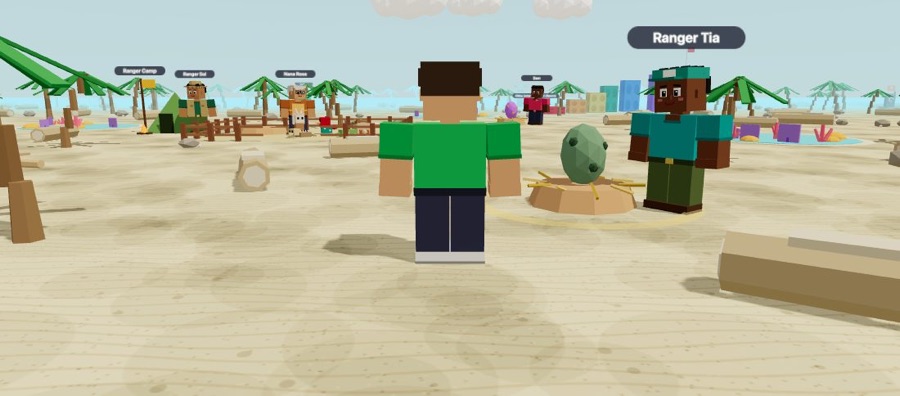
Snorkel the biggest coral reef on Earth and visit the islands of the Torres Strait. Characters here greet you with “G'day!” (hello in Australian English), and eggs hatch into hybrids of animals like broadclub cuttlefish, day octopus, green sea turtle and dugong.
What your child practices
Follows Geometry (5.G).
The Coordinate Plane
Find points with (x, y): go right x first, then up y.
5.G.A.1
Maps and Coordinates
Use a reef map grid to track trips, distances and patterns.
5.G.A.2
Sorting 2D Shapes
Name triangles and four-sided shapes like the parallelogram, rhombus and trapezium (trapezoid) from their sides and angles.
5.G.B.3, 5.G.B.4
Angles in Triangles
The angles of a triangle add up to 180°. Use that, and what you know about isosceles, equilateral and right-angled triangles, to find a missing angle.
5.G.B.3, 8.G.A.5
Angles on Lines and Points
Angles on a straight line make 180°, around a point 360°, and vertically opposite angles match.
4.MD.C.7, 7.G.B.5
Angles in Quadrilaterals
Find missing angles in parallelograms, rhombuses and trapeziums (trapezoids).
5.G.B.3
Area of a Triangle
Pick a base and the height that meets it at a right angle. Area = 1/2 × base × height.
6.G.A.1
Try a problem from Great Barrier Reef and Torres Strait
Every problem is a short story set in the world. These are real problems from the game. Kids get endless new ones with different numbers.
You find a mystery egg on the beach at point (0, 2) on your map.
You carry it 4 units right and 6 units up to your farm’s incubator.
What are the coordinates of the incubator?
Show the answer
(4, 8)
- Right 4: x = 0 + 4 = 4.
- Up 6: y = 2 + 6 = 8.
- The new point is (4, 8).
On the reef map, each grid unit stands for 10 m.
Your canoe is at (4, 5) and the manta ray cleaning station is at (4, 6).
How far is it from your canoe to the manta ray cleaning station?
Show the answer
10 m
- Only the y-coordinate changes: 6 − 5 = 1 units.
- 1 × 10 = 10 m.
You draw a shape in the sand with 4 sides, each 5 cm long.
None of its angles are right angles.
Which name fits this shape best?
Show the answer
Rhombus
- 4 equal sides makes it a rhombus.
- It has no right angles, so it is not a square.
Common mistakes, and how to help
Every wrong answer in Mixmonde is planned: it points to a named mistake, and the tip after a miss explains it with that problem’s numbers. These are the mistakes this world watches for, grouped the way the grown-ups’ dashboard shows them.
-
Order and direction
The right idea done the wrong way round: taking the smaller digit from the bigger one, dividing backwards, swapping x and y, or flipping more and less.
Mistakes we catch: swapped x and y, mixed up right and up and mixed up east and north.
Try at home: For ratios and coordinates, write labels on the numbers (“birds : eggs”, “across, then up”) and check the order matches the question.
-
Choosing the operation
The arithmetic is fine, but the wrong operation was picked: adding when the story takes away, or multiplying when it shares out.
Mistakes we catch: added coordinates instead of finding the change.
Try at home: Have them say the plan in words first (“share 48 into groups of 6, so divide”). Swap in easy numbers to see which operation makes sense, then use the real ones.
-
Counting and sequences
Losing track while counting: off by one, skipping or double-counting, or counting the wrong things (fence posts instead of gaps).
Mistakes we catch: counted gridlines instead of spaces.
Try at home: For patterns and sequences, write the first few terms in a table and say what changes each step before jumping to the 20th term.
-
Reading the question
The math works, but the answer is to a different question: a number already given, a halfway step, or only part of a two-step problem.
Mistakes we catch: counted only one direction, left out one of the moves, forgot the starting point, subtracted only one angle, left out a known angle and left out part of the figure.
Try at home: Underline what the question asks for and list the steps (“first find …, then …”). Tick each step off before giving the answer.
-
Ratio and scaling
Adding when the situation multiplies: doubling a recipe by adding 2 to each amount, or taking a percent of the wrong total.
Mistakes we catch: forgot the map scale.
Try at home: Compare prices at the shop per item or per 100 g. For percents, always ask “percent of what?” and start from 10% and 1%.
-
Shapes and angles
Shape properties: counting sides, corners or faces, symmetry, naming angles, measuring with a protractor or radius vs diameter.
Mistakes we catch: thought shape names cannot overlap, read the shape family backwards, named a shape from one property, mixed up the properties of different shapes, mixed up triangle names, sorted a triangle by most of its angles, used 360° for a triangle, forgot to share between equal angles, picked the wrong equal angles, forgot the right angle, used 90° for a straight line, used 360° for a straight line, used 180° around a point, mixed up opposite and next-door angles, mixed up equal angles and angles that add to 180° and used 360° for two angles.
Try at home: Unfold a cereal box to see its net. Measure angles with a protractor together, checking first whether the angle is smaller or bigger than a right angle.
-
Units and measuring
The number is fine but the unit is off: a missing conversion (cm and m), the ruler not started at zero, or area mixed up with perimeter.
Mistakes we catch: forgot the 1/2, used a slanted side as the height, added the outside part to the base and matched a height with the wrong base.
Try at home: Before converting, ask whether the answer should be a bigger or smaller number. Fill a box with cubes to feel why volume uses cubic units.
Ready to hatch the first egg? A grown-up creates the account in a minute, then it’s off to the first world. Kindergarten and Grade 1 are free. The other grades come with a membership.
Create a free accountMore Grade 5 worlds: Place Value & Decimals · Expressions & Patterns · Fractions · Measurement & Data · Ratio, Rate & Percent