 Mixmonde
Play free
Place Value & Decimals: 5th grade math in Morocco and the Sahara
Big numbers, powers of 10, decimals to thousandths, and multi-digit operations.
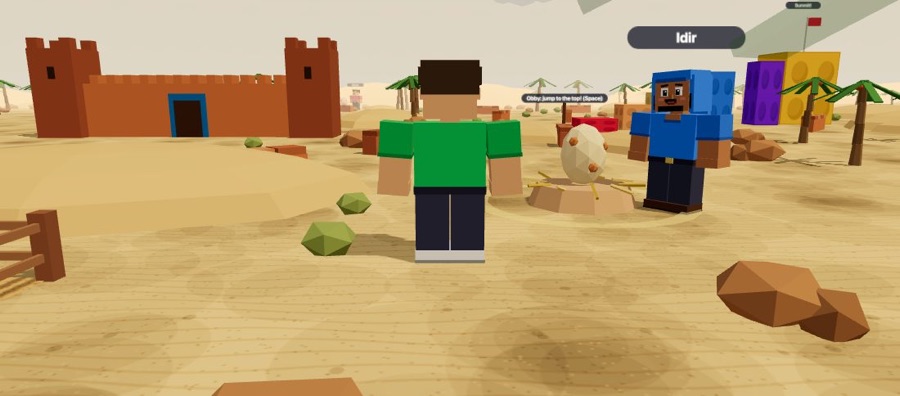
Cross golden dunes, tiled cities and snowy mountains, all in one country. Characters here greet you with “Salam!” (hello in Moroccan Arabic (Darija)), and eggs hatch into hybrids of animals like fennec fox, dromedary camel, sand cat and lesser Egyptian jerboa.
What your child practices
Follows Number & Operations in Base Ten (5.NBT).
Whole Numbers to 10 Million
Read, write and compare big numbers up to 10 million.
4.NBT.A.2, 5.NBT.A.1
Place Value Patterns
Each place is worth 10 times the place to its right.
5.NBT.A.1
Multiply & Divide by 10, 100, 1000
Slide digits left or right to multiply or divide by 10, 100, 1000 (10¹, 10², 10³) and their multiples.
5.NBT.A.2
Decimals to Thousandths
Read, write and compare decimals with tenths, hundredths and thousandths.
5.NBT.A.3
Rounding Decimals
Round decimals to the nearest whole number, tenth or hundredth.
5.NBT.A.4
Multi-Digit Multiplication
Multiply big numbers by 2-digit numbers, row by row.
5.NBT.B.5
Dividing by 2-Digit Numbers
Divide big numbers by 2-digit numbers and decide what to do with leftovers.
5.NBT.B.6
Decimal Operations
Add, subtract, multiply and divide decimals to hundredths.
5.NBT.B.7
Rounding & Estimating
Round big numbers to the nearest 1000, estimate answers, and spot the answer that makes sense.
4.NBT.A.3, 4.OA.A.3
Decimal Word Problems
Solve decimal story problems, round answers, estimate, and check that answers make sense.
5.NBT.A.2, 5.NBT.A.4, 5.NBT.B.7
Try a problem from Morocco and the Sahara
Every problem is a short story set in the world. These are real problems from the game. Kids get endless new ones with different numbers.
The souk sold three million, thirty-three thousand, six hundred fifty-seven glasses of mint tea this year.
A Barbary macaque grabs the chalk, so you write it in numerals.
How do you write that number in numerals?
Show the answer
3033657
- Three million: 3 in the millions place.
- Thirty-three thousand: the thousands group is 033.
- Six hundred fifty-seven: the last group is 657.
- Put the groups together: 3,033,657.
The dial on your egg's incubator shows 61,164.
The number has two 6s in it.
The 6 on the left is worth how many times as much as the 6 on the right?
Show the answer
1000
- The left 6 is in the ten-thousands place, so it is worth 60,000.
- The right 6 is in the tens place, so it is worth 60.
- 60,000 ÷ 60 = 1,000.
The oasis tank holds 92.55 ℓ of water. It fills 10 drinking troughs equally.
How many liters go in each trough?
Show the answer
9.255 ℓ
- Divide 92.55 by 10.
- Dividing by 10 moves each digit 1 place to the right.
- 92.55 ÷ 10 = 9.255.
Common mistakes, and how to help
Every wrong answer in Mixmonde is planned: it points to a named mistake, and the tip after a miss explains it with that problem’s numbers. These are the mistakes this world watches for, grouped the way the grown-ups’ dashboard shows them.
-
Place value
The digits are right but their places are not: a 3 in the tens is worth 30, not 3. This shows up when carrying, borrowing, lining up numbers or placing a decimal point.
Mistakes we catch: missing placeholder zeros, skipped zeros inside a group, digit instead of its value, miscounted places, compares first digits only, compares later digits, adds 10 per place, reversed the relationship, moved the wrong way, added a zero at the end, wrong number of places, shifted the wrong way, tacked zeros onto a decimal, forgot the power of 10, missing placeholder zero, miscounted decimal places, hundreds for hundredths, always rounds down, rounded to the wrong place, rounded in steps, forgot the placeholder zero, only used the ones digit, missing zero in the answer, lined up the last digits, misplaced point in a product, misplaced point in a quotient and did not check the size.
Try at home: Use a place-value chart that goes past the decimal point (tenths, hundredths). Multiply and divide a number by 10 and 100 by sliding the digits along the chart, never by “adding a zero”.
-
Expressions and equations
Order of operations, unknowns and the equals sign: reading “=” as “the answer comes next” instead of “both sides balance”.
Mistakes we catch: read an exponent as times.
Try at home: Write “mystery number” riddles for each other (“I double it and add 3, I get 17”). Solve by undoing the steps, last one first.
-
Fractions and decimals
Treating the top and bottom of a fraction as two separate whole numbers (so 1/2 + 1/3 = 2/5), thinking a bigger bottom number means a bigger piece, or reading 0.25 as bigger than 0.3.
Mistakes we catch: longer means larger and shorter means larger.
Try at home: Put fractions and decimals on one number line from 0 to 1 (0.3, 1/4, 0.25, 1/2). For adding, cut both into the same size pieces first.
-
Choosing the operation
The arithmetic is fine, but the wrong operation was picked: adding when the story takes away, or multiplying when it shares out.
Mistakes we catch: added instead of multiplied and missed a wrong operation.
Try at home: Have them say the plan in words first (“share 48 into groups of 6, so divide”). Swap in easy numbers to see which operation makes sense, then use the real ones.
-
Reading the question
The math works, but the answer is to a different question: a number already given, a halfway step, or only part of a two-step problem.
Mistakes we catch: ignored the leftovers, counted a partial group, gave the quotient, not the remainder, worked out the exact answer, stopped after rounding and stopped after one step.
Try at home: Underline what the question asks for and list the steps (“first find …, then …”). Tick each step off before giving the answer.
Ready to hatch the first egg? A grown-up creates the account in a minute, then it’s off to the first world. Kindergarten and Grade 1 are free. The other grades come with a membership.
Create a free accountMore Grade 5 worlds: Expressions & Patterns · Fractions · Measurement & Data · Geometry · Ratio, Rate & Percent