 Mixmonde
Play free
Measurement & Data: 5th grade math in Siberia
Unit conversions, volume, line plots and averages.
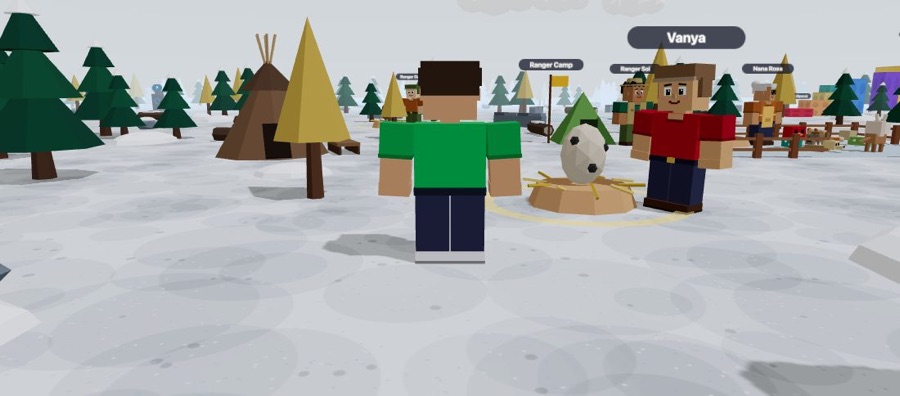
Explore the biggest forest on Earth and the deepest lake in the world. Characters here greet you with “Privet!” (hi in Russian), and eggs hatch into hybrids of animals like Arctic fox, snowy owl, reindeer and Siberian crane.
What your child practices
Follows Measurement & Data (5.MD).
Converting Measurements
Change km to m, kg to g, ℓ to mℓ, ft to in and more, including decimals.
5.MD.A.1
Volume with Unit Cubes
Build with unit cubes and count them layer by layer to find volume.
5.MD.C.3, 5.MD.C.4
Volume Formula
Use length × width × height to find volume in cm³ or m³, or work back to an edge.
5.MD.C.5
Liquid in Tanks
Find the water in a tank and convert between ℓ, mℓ and cm³.
5.MD.C.5
Combined Volumes
Solve multi-step volume problems: shapes made of two boxes, cutting cubes, and space left over.
5.MD.C.5
Line Plots with Fractions
Read fraction data from a line plot and find totals and fair shares.
5.MD.B.2
Average
Average = total ÷ number of items. Find an average, a total, or a missing value.
6.SP.B.5
Try a problem from Siberia
Every problem is a short story set in the world. These are real problems from the game. Kids get endless new ones with different numbers.
The ice road across Lake Baikal to the fishing camp is 7.4 km long.
How many meters is that?
Show the answer
7400 m
- 1 km = 1,000 m.
- Bigger unit to smaller unit: multiply.
- 7.4 × 1,000 = 7,400 m.
The farm builds a habitat pen for a tiger hatchling from 1-m cubes of packed snow.
Each layer has 12 cubes. There are 4 layers.
What is the volume of the pen in m³?
Show the answer
48 m³
- One layer has 12 cubes.
- 4 layers: 12 × 4 = 48.
- Each 1-m snow cube is 1 m³, so the volume is 48 m³.
A reindeer herder makes a cube-shaped wooden egg box.
Each edge of the cube is 14 cm long.
What is the volume of the cube in cm³?
Show the answer
2744 cm³
- A cube has length, width and height all equal to 14 cm.
- 14 × 14 = 196.
- 196 × 14 = 2,744 cm³.
Common mistakes, and how to help
Every wrong answer in Mixmonde is planned: it points to a named mistake, and the tip after a miss explains it with that problem’s numbers. These are the mistakes this world watches for, grouped the way the grown-ups’ dashboard shows them.
-
Units and measuring
The number is fine but the unit is off: a missing conversion (cm and m), the ruler not started at zero, or area mixed up with perimeter.
Mistakes we catch: multiplied or divided the wrong way, wrong conversion number, counted one layer only, forgot the height, squared instead of cubed, divided by one edge, used the tank height, forgot to convert, wrong conversion, filled in the gap and divided by the edge, not the cube’s volume.
Try at home: Before converting, ask whether the answer should be a bigger or smaller number. Fill a box with cubes to feel why volume uses cubic units.
-
Place value
The digits are right but their places are not: a 3 in the tens is worth 30, not 3. This shows up when carrying, borrowing, lining up numbers or placing a decimal point.
Mistakes we catch: missing placeholder zero.
Try at home: Use a place-value chart that goes past the decimal point (tenths, hundredths). Multiply and divide a number by 10 and 100 by sliding the digits along the chart, never by “adding a zero”.
-
Choosing the operation
The arithmetic is fine, but the wrong operation was picked: adding when the story takes away, or multiplying when it shares out.
Mistakes we catch: added instead of multiplied, multiplied instead of divided, added the edges, added instead of subtracted, divided instead of multiplied and multiplied by the count.
Try at home: Have them say the plan in words first (“share 48 into groups of 6, so divide”). Swap in easy numbers to see which operation makes sense, then use the real ones.
-
Reading the question
The math works, but the answer is to a different question: a number already given, a halfway step, or only part of a two-step problem.
Mistakes we catch: forgot the cubes already used, found the water, not the space, counted one part only and gave the average.
Try at home: Underline what the question asks for and list the steps (“first find …, then …”). Tick each step off before giving the answer.
-
Expressions and equations
Order of operations, unknowns and the equals sign: reading “=” as “the answer comes next” instead of “both sides balance”.
Mistakes we catch: divided by 3 and divided only one value.
Try at home: Write “mystery number” riddles for each other (“I double it and add 3, I get 17”). Solve by undoing the steps, last one first.
-
Graphs and data
Reading graphs: missing that one picture stands for several, misreading the scale, or mixing up mean, median and range.
Mistakes we catch: ignored how many, forgot to share, divided by the number of values, included the boundary, divided by the wrong count, forgot to divide and used only the known values.
Try at home: Collect real numbers (bedtimes, scores) and find the mean, median and range together. Ask which one best describes “a typical day”.
Ready to hatch the first egg? A grown-up creates the account in a minute, then it’s off to the first world. Kindergarten and Grade 1 are free. The other grades come with a membership.
Create a free accountMore Grade 5 worlds: Place Value & Decimals · Expressions & Patterns · Fractions · Geometry · Ratio, Rate & Percent