 Mixmonde
Play free
Fractions: 5th grade math in Amazon Rainforest
Adding, subtracting, multiplying and dividing fractions and mixed numbers.
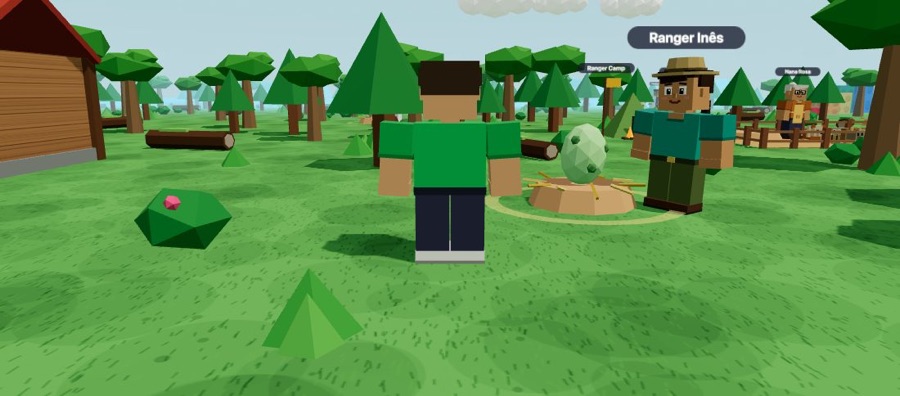
Paddle a flooded forest where pink dolphins swim between the trees. Characters here greet you with “Olá!” (hello in Brazilian Portuguese), and eggs hatch into hybrids of animals like pink river dolphin, fishing bat, three-toed sloth and glass frog.
What your child practices
Follows Number & Operations — Fractions (5.NF).
Fractions as Division
Sharing 3 mangoes among 4 hatchlings? Each gets 3 ÷ 4 = 3/4 of a mango.
5.NF.B.3
Fractions and Decimals
Turn 3/4 into 0.75 and 0.4 into 2/5 by thinking in tenths and hundredths.
4.NF.C.6
Adding and Subtracting Unlike Fractions
Rename fractions so they share a bottom number, then add or subtract.
5.NF.A.1
Adding and Subtracting Mixed Numbers
Work with wholes and fractions, and trade a whole when you need more pieces.
5.NF.A.1
Estimating with Benchmarks
Compare fractions to 0, 1/2 and 1 to check if an answer makes sense.
5.NF.A.2
Fraction Times a Whole Number
5 × 3/4 means 5 groups of 3/4, which is 15/4 or 3 3/4.
5.NF.B.4
Multiplying Fractions
Multiply top times top and bottom times bottom, like finding 2/3 of 3/4 or 5/2 × 7/3.
5.NF.B.4
Multiplying Mixed Numbers
3 × 2 1/4 is 3 groups of 2 wholes and 3 groups of 1/4.
5.NF.B.6
Multiplication as Scaling
Times a fraction less than 1 shrinks a number; times more than 1 makes it grow.
5.NF.B.5
Dividing with Unit Fractions
Share 1/3 among 2 hatchlings, or count how many 1/4s fit in 3.
5.NF.B.7
Dividing a Fraction by a Whole Number
Share 3/4 among 2: each gets 3/4 × 1/2 = 3/8.
5.NF.B.7, 6.NS.A.1
Fraction Word Problems
Two-step stories with fractions: add, subtract, multiply and divide, one step at a time.
5.NF.A.2, 5.NF.B.6, 5.NF.B.7
Try a problem from Amazon Rainforest
Every problem is a short story set in the world. These are real problems from the game. Kids get endless new ones with different numbers.
At a floating market in Manaus, a seller has 5 kg of Brazil nuts.
The seller packs them equally into 2 bags.
How many kilograms of nuts go in each bag?
Show the answer
2 1/2 kg
- Sharing 5 equally among 2 means 5 ÷ 2.
- 5 ÷ 2 = 5/2.
- 5/2 = 2 1/2, because 2 × 2 = 4 with 1 left over.
- Each share is 2 1/2.
You are measuring how far a pink river dolphin swam beside your boat.
It measures 3/8 km.
The boat’s screen only shows decimals.
What is 3/8 written as a decimal?
Show the answer
0.375 km
- Make the bottom number 1000: 3/8 = 375/1000.
- 375/1000 = 0.375.
You pick 3/4 kg of açaí berries for your hatchling.
A friendly river guide drops 11/12 kg more into your basket.
How many kilograms of berries do you have now?
Show the answer
1 2/3 kg
- Use 12 as the common bottom number.
- 3/4 = 9/12 and 11/12 = 11/12.
- 9/12 + 11/12 = 20/12.
- 20/12 = 1 2/3.
Common mistakes, and how to help
Every wrong answer in Mixmonde is planned: it points to a named mistake, and the tip after a miss explains it with that problem’s numbers. These are the mistakes this world watches for, grouped the way the grown-ups’ dashboard shows them.
-
Order and direction
The right idea done the wrong way round: taking the smaller digit from the bigger one, dividing backwards, swapping x and y, or flipping more and less.
Mistakes we catch: divided in the wrong order and divided the bottom by the top.
Try at home: For ratios and coordinates, write labels on the numbers (“birds : eggs”, “across, then up”) and check the order matches the question.
-
Fractions and decimals
Treating the top and bottom of a fraction as two separate whole numbers (so 1/2 + 1/3 = 2/5), thinking a bigger bottom number means a bigger piece, or reading 0.25 as bigger than 0.3.
Mistakes we catch: left out the leftover part, shared only one thing, read the fraction bar as a decimal point, put the digits in the wrong decimal place, added or subtracted tops and bottoms, changed the bottom number but not the top, forgot to regroup a whole, subtracted the smaller fraction from the larger, did not compare with a benchmark, trusted adding tops and bottoms, multiplied the top and the bottom, multiplied the bottom number, dropped the bottom number, cross-multiplied, kept the same bottom number, multiplied only the whole part, changed to an improper fraction the wrong way, thought multiplying always makes bigger, thought any fraction makes smaller and divided the top and the bottom.
Try at home: Put fractions and decimals on one number line from 0 to 1 (0.3, 1/4, 0.25, 1/2). For adding, cut both into the same size pieces first.
-
Choosing the operation
The arithmetic is fine, but the wrong operation was picked: adding when the story takes away, or multiplying when it shares out.
Mistakes we catch: added instead of multiplied, multiplied instead of divided, divided by the bottom number and used the wrong operation.
Try at home: Have them say the plan in words first (“share 48 into groups of 6, so divide”). Swap in easy numbers to see which operation makes sense, then use the real ones.
-
Reading the question
The math works, but the answer is to a different question: a number already given, a halfway step, or only part of a two-step problem.
Mistakes we catch: took the fraction of the whole, not of what was left, stopped after the first step and multiplied only one of the amounts.
Try at home: Underline what the question asks for and list the steps (“first find …, then …”). Tick each step off before giving the answer.
Ready to hatch the first egg? A grown-up creates the account in a minute, then it’s off to the first world. Kindergarten and Grade 1 are free. The other grades come with a membership.
Create a free accountMore Grade 5 worlds: Place Value & Decimals · Expressions & Patterns · Measurement & Data · Geometry · Ratio, Rate & Percent