 Mixmonde
Play free
Statistics: 6th grade math in The Pantanal
Statistical questions, mean, median, MAD, dot plots, histograms, box plots and pie charts.
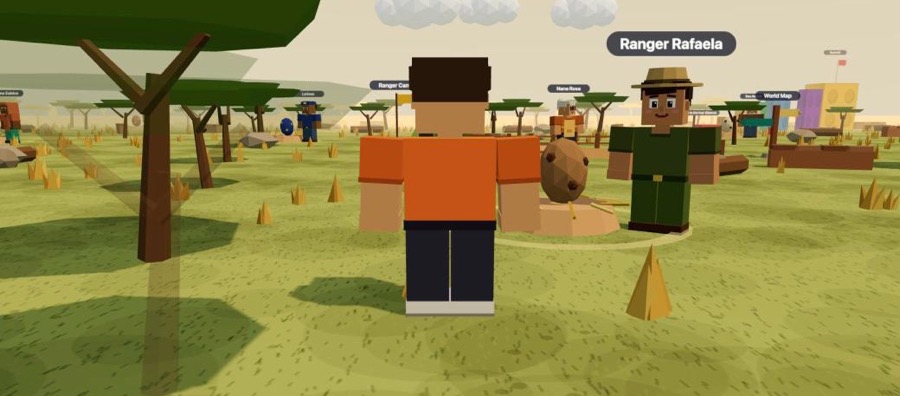
Ride with pantaneiro cowboys across the biggest wetland on Earth, where jaguars swim and capybaras graze. Characters here greet you with “Olá!” (hello in Portuguese), and eggs hatch into hybrids of animals like jaguar, capybara, yacare caiman and giant otter.
What your child practices
Follows Statistics & Probability (6.SP), plus pie charts (Singapore P6).
Statistical questions
A statistical question has answers that vary, so you collect data to answer it.
6.SP.A.1
Mean (average)
The mean is the total shared equally: add the values and divide by how many there are.
6.SP.B.5c
Median, mode and range
Median is the middle value in order, mode is the most common value, range is largest minus smallest.
6.SP.A.3, 6.SP.B.5c
Mean absolute deviation
Find how far each value is from the mean, then find the mean of those distances.
6.SP.B.5c
Dot plots and histograms
Read dot plots and histograms: each dot is one item, each bar’s height is a count.
6.SP.B.4
Box plots
Read the median, quartiles, range and interquartile range from a box plot.
6.SP.B.4, 6.SP.B.5c
Pie charts
A pie chart splits a whole circle into parts. Use the fractions or percents to find amounts.
6.SP.B.4
Try a problem from The Pantanal
Every problem is a short story set in the world. These are real problems from the game. Kids get endless new ones with different numbers.
A pantaneiro cowboy helps a team of young scientists plan their survey.
A statistical question is one you answer by collecting data that varies.
Which of these is a statistical question?
Show the answer
How long are the caimans resting on the sandbanks?
- A statistical question expects answers that vary.
- “How long are the caimans resting on the sandbanks?” asks about many, and the answers will be different.
- The other questions each have one answer.
A ranger times how long a giant otter stays underwater when it dives for fish.
The mean of 5 dives is 40 seconds. The first 4 dives last 40, 45, 50 and 37 seconds.
How many seconds does the last dive last?
Show the answer
28 seconds
- Total for all 5: 40 × 5 = 200.
- Known total: 40 + 45 + 50 + 37 = 172.
- Last one: 200 − 172 = 28.
On the Transpantaneira road, explorers count hyacinth macaws at each wooden bridge.
At the bridges they count 24, 15, 22, 12, 25, 25 and 6 macaws.
What is the median number of macaws at a bridge?
Show the answer
22
- In order: 6, 12, 15, 22, 24, 25, 25.
- The middle value is 22.
Common mistakes, and how to help
Every wrong answer in Mixmonde is planned: it points to a named mistake, and the tip after a miss explains it with that problem’s numbers. These are the mistakes this world watches for, grouped the way the grown-ups’ dashboard shows them.
-
Graphs and data
Reading graphs: missing that one picture stands for several, misreading the scale, or mixing up mean, median and range.
Mistakes we catch: picked a question with one answer, picked a question about one individual, thought numbers make it statistical, forgot to divide, divided by the wrong count, used only the known values, did not put the data in order, picked one of two middle values, gave the mean, gave how often, not the value, miscounted the mode, gave the largest value, used the first and last values, used signed differences, thought a bigger mean means more spread, ignored the mean absolute deviation, added the numbers on the line, counted columns, not dots, counted dots, not the total, left out the boundary value, used only one bar, counted bars, not heights, took the center as the median, gave the range, measured from the median, gave the interquartile range, used the wrong side, thought every part is half, read a percent as a count, divided by the percent, gave the known part, took the percent of the part, added the percent, gave the percent difference and gave one slice.
Try at home: Collect real numbers (bedtimes, scores) and find the mean, median and range together. Ask which one best describes “a typical day”.
-
Reading the question
The math works, but the answer is to a different question: a number already given, a halfway step, or only part of a two-step problem.
Mistakes we catch: gave the mean.
Try at home: Underline what the question asks for and list the steps (“first find …, then …”). Tick each step off before giving the answer.
-
Choosing the operation
The arithmetic is fine, but the wrong operation was picked: adding when the story takes away, or multiplying when it shares out.
Mistakes we catch: added instead of multiplied.
Try at home: Have them say the plan in words first (“share 48 into groups of 6, so divide”). Swap in easy numbers to see which operation makes sense, then use the real ones.
Ready to hatch the first egg? A grown-up creates the account in a minute, then it’s off to the first world. Kindergarten and Grade 1 are free. The other grades come with a membership.
Create a free accountMore Grade 6 worlds: Ratios, Rates & Percent · Fractions, Decimals & Factors · Negative Numbers & Coordinates · Expressions & Equations · Area, Volume & Circles