 Mixmonde
Play free
Expressions & Equations: 6th grade math in The Canadian Rockies
Exponents, writing and evaluating expressions, equivalent expressions, one-step equations and inequalities.
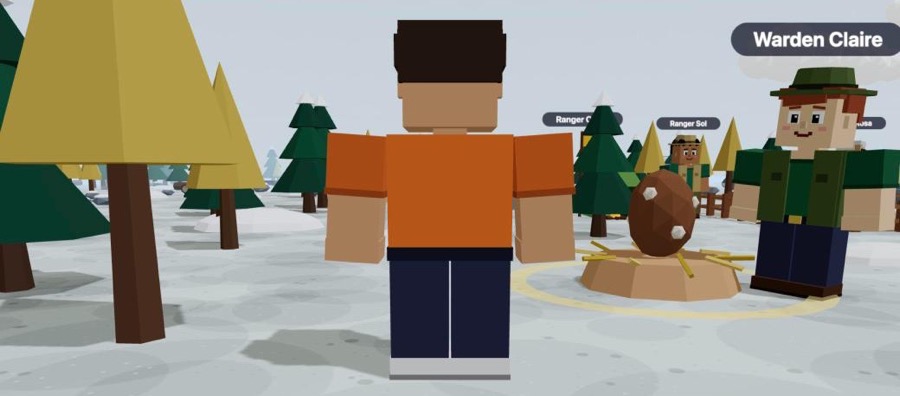
Hike past turquoise lakes and glaciers where grizzlies, elk and mountain goats roam. Characters here greet you with “Hello! Bonjour!” (hello in English and French), and eggs hatch into hybrids of animals like grizzly bear, American black bear, elk and moose.
What your child practices
Follows Expressions & Equations (6.EE).
Exponents
A small raised number says how many times to multiply a number by itself.
6.EE.A.1
Writing expressions with letters
Use a letter for an unknown number and write expressions like y + 2, 3y and (3 + y) ÷ 5.
6.EE.A.2a, 6.EE.A.2b, 6.EE.B.6
Evaluating expressions
Put a number in place of the letter and work out the value, using the order of operations.
6.EE.A.2c
Simplifying and equivalent expressions
Combine like terms, multiply out brackets and take out common factors to write equivalent expressions.
6.EE.A.3, 6.EE.A.4
One-step equations
Find the unknown by undoing the operation, and check the answer by putting it back in.
6.EE.B.5, 6.EE.B.7
Inequalities
Write and read inequalities like y > 5 and y ≤ 8, and know they have many solutions.
6.EE.B.8
Algebra word problems
Write expressions and equations for stories, and see how one quantity depends on another.
6.EE.B.6, 6.EE.C.9
Try a problem from The Canadian Rockies
Every problem is a short story set in the world. These are real problems from the game. Kids get endless new ones with different numbers.
A riddle stone on the shore of Lake Louise is carved with 4².
It glows turquoise when an explorer says its value out loud.
What is the value of 4²?
Show the answer
16
- 4² means 4 × 4.
- Multiply: 4 × 4 = 16.
Ranger Theo writes 4y on the board at the Jasper ranger station.
He asks the explorers to say it another way.
Which expression means the same as 4y?
Show the answer
y + y + y + y
- 4y means 4 × y.
- That is the same as adding y 4 times: y + y + y + y.
The incubator at the Banff hatchery heats up by (90 − y) ÷ 6 degrees.
The dial shows y = 18.
What is the value of (90 − y) ÷ 6 when y = 18?
Show the answer
12
- Put 18 in place of y: (90 − 18) ÷ 6.
- Brackets first: 72.
- Then divide: 72 ÷ 6 = 12.
Common mistakes, and how to help
Every wrong answer in Mixmonde is planned: it points to a named mistake, and the tip after a miss explains it with that problem’s numbers. These are the mistakes this world watches for, grouped the way the grown-ups’ dashboard shows them.
-
Expressions and equations
Order of operations, unknowns and the equals sign: reading “=” as “the answer comes next” instead of “both sides balance”.
Mistakes we catch: multiplied base by exponent, added base and exponent, wrong number of factors, exponent out of order, read 3y as 3 + y, mixed up 3y and y³, read y/2 as 2y, missing brackets, mixed up the parts, wrote 3y as digits, added the coefficient, order of operations, squared as doubled, multiplied instead of divided, combined unlike terms, adding made a power, multiplied like terms, forgot y means 1y, multiplied only one term, lost the minus sign, divided only one term, did the operation again, undid with the wrong operation, added when the unknown was taken away, included or left out the edge, thought there is one answer, brackets in the wrong place and checked only one row.
Try at home: Write “mystery number” riddles for each other (“I double it and add 3, I get 17”). Solve by undoing the steps, last one first.
-
Order and direction
The right idea done the wrong way round: taking the smaller digit from the bigger one, dividing backwards, swapping x and y, or flipping more and less.
Mistakes we catch: swapped base and exponent, subtraction in the wrong order, division in the wrong order, sign the wrong way and swapped the variables.
Try at home: For ratios and coordinates, write labels on the numbers (“birds : eggs”, “across, then up”) and check the order matches the question.
-
Place value
The digits are right but their places are not: a 3 in the tens is worth 30, not 3. This shows up when carrying, borrowing, lining up numbers or placing a decimal point.
Mistakes we catch: lost decimal places.
Try at home: Use a place-value chart that goes past the decimal point (tenths, hundredths). Multiply and divide a number by 10 and 100 by sliding the digits along the chart, never by “adding a zero”.
-
Choosing the operation
The arithmetic is fine, but the wrong operation was picked: adding when the story takes away, or multiplying when it shares out.
Mistakes we catch: wrong operation and times read as plus.
Try at home: Have them say the plan in words first (“share 48 into groups of 6, so divide”). Swap in easy numbers to see which operation makes sense, then use the real ones.
-
Reading the question
The math works, but the answer is to a different question: a number already given, a halfway step, or only part of a two-step problem.
Mistakes we catch: stopped too soon, stopped after one step and found only one part.
Try at home: Underline what the question asks for and list the steps (“first find …, then …”). Tick each step off before giving the answer.
Ready to hatch the first egg? A grown-up creates the account in a minute, then it’s off to the first world. Kindergarten and Grade 1 are free. The other grades come with a membership.
Create a free accountMore Grade 6 worlds: Ratios, Rates & Percent · Fractions, Decimals & Factors · Negative Numbers & Coordinates · Area, Volume & Circles · Statistics