 Mixmonde
Play free
Negative Numbers & Coordinates: 6th grade math in The Congo Rainforest
Negative numbers in real life, the number line, absolute value and the four-quadrant coordinate plane.
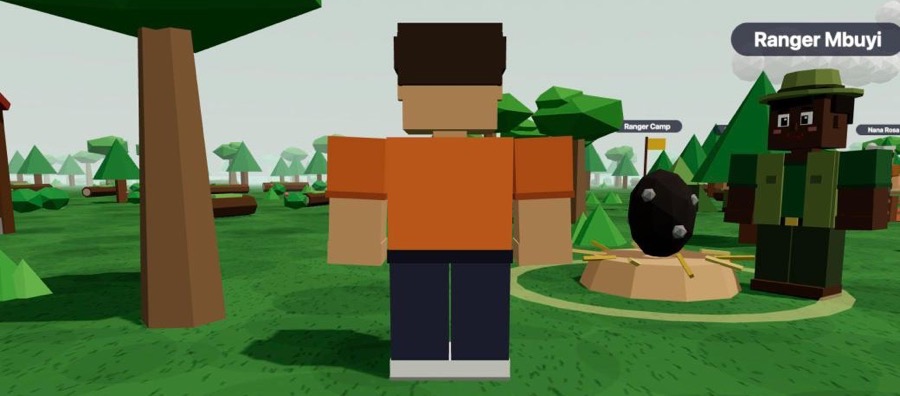
Paddle a pirogue down the mighty Congo River, deep into the second-largest rainforest on Earth. Characters here greet you with “Mbote!” (hello in Lingala), and eggs hatch into hybrids of animals like okapi, bongo, bonobo and chimpanzee.
What your child practices
Follows The Number System — rational numbers (6.NS.C).
Positive and negative numbers in real life
Above zero is positive, below zero is negative: depths, temperatures, river levels and debts.
6.NS.C.5
Negative numbers on the number line
Negative numbers sit left of zero; opposites are the same distance from zero on either side.
6.NS.C.6a, 6.NS.C.6c
Comparing and ordering positive and negative numbers
Farther right on the number line is greater, so −3 is greater than −8.
6.NS.C.7a, 6.NS.C.7b
Absolute value
Absolute value is distance from zero: |−12| = 12, and a balance of −$40 is a debt of $40.
6.NS.C.7c, 6.NS.C.7d
The coordinate plane in four quadrants
Left of the y-axis, x is negative; below the x-axis, y is negative.
6.NS.C.6b, 6.NS.C.6c
Distance between points on a grid
Points on the same gridline: add the distances to the axis if they are on opposite sides, subtract if on the same side.
6.NS.C.8
Try a problem from The Congo Rainforest
Every problem is a short story set in the world. These are real problems from the game. Kids get endless new ones with different numbers.
Your pirogue’s depth line shows a catfish swimming 17 meters below the surface of the Congo River.
The river’s surface is 0.
Which number shows where the catfish is?
Show the answer
−17
- 0 is the starting point.
- 17 below the surface is below 0, so it is negative.
- The number is −17.
A riddle stone on the riverbank says: “Start at 18.
Jump to its opposite. Then jump to the opposite of that.”
Where do you land?
Show the answer
18
- The opposite of 18 is −18.
- The opposite of −18 is 18.
- You land back on 18.
A riddle stone near a hidden egg reads 6 > −19.
You picture both numbers on a number line.
What does this statement tell you?
Show the answer
6 is to the right of −19
- On a number line, the greater number is always to the right.
- So 6 is to the right of −19.
Common mistakes, and how to help
Every wrong answer in Mixmonde is planned: it points to a named mistake, and the tip after a miss explains it with that problem’s numbers. These are the mistakes this world watches for, grouped the way the grown-ups’ dashboard shows them.
-
Negative numbers
Numbers below zero: comparing them (−5 is smaller than −2), counting across zero on a number line, and sign rules.
Mistakes we catch: used the wrong sign, thought zero means nothing is there, thought nothing can be below zero, kept the same sign for the opposite, thought the opposite of an opposite stays opposite, mixed up left and right of zero, thought a negative with bigger digits is greater, ordered by distance from zero, put the order backwards, ordered the negative numbers backwards, kept the minus sign in an absolute value, thought absolute value means the opposite, mixed up greater with farther from zero, left out a negative sign, flipped both signs, read only one sign for the quadrant, reflected across the wrong axis, subtracted when the points are on opposite sides, added when the points are on the same side and moved the wrong way.
Try at home: Track a bank balance or a temperature over a week with ups and downs, including below zero. Compare which day was coldest.
-
Counting and sequences
Losing track while counting: off by one, skipping or double-counting, or counting the wrong things (fence posts instead of gaps).
Mistakes we catch: counted tick marks instead of reading their values and counted gridlines instead of spaces.
Try at home: For patterns and sequences, write the first few terms in a table and say what changes each step before jumping to the 20th term.
-
Order and direction
The right idea done the wrong way round: taking the smaller digit from the bigger one, dividing backwards, swapping x and y, or flipping more and less.
Mistakes we catch: swapped x and y.
Try at home: For ratios and coordinates, write labels on the numbers (“birds : eggs”, “across, then up”) and check the order matches the question.
-
Shapes and angles
Shape properties: counting sides, corners or faces, symmetry, naming angles, measuring with a protractor or radius vs diameter.
Mistakes we catch: numbered the quadrants clockwise and changed the wrong coordinate.
Try at home: Unfold a cereal box to see its net. Measure angles with a protractor together, checking first whether the angle is smaller or bigger than a right angle.
-
Reading the question
The math works, but the answer is to a different question: a number already given, a halfway step, or only part of a two-step problem.
Mistakes we catch: counted only one direction.
Try at home: Underline what the question asks for and list the steps (“first find …, then …”). Tick each step off before giving the answer.
Ready to hatch the first egg? A grown-up creates the account in a minute, then it’s off to the first world. Kindergarten and Grade 1 are free. The other grades come with a membership.
Create a free accountMore Grade 6 worlds: Ratios, Rates & Percent · Fractions, Decimals & Factors · Expressions & Equations · Area, Volume & Circles · Statistics