 Mixmonde
Play free
Area, Volume & Circles: 6th grade math in The Belize Barrier Reef
Area of triangles and composite figures, circles, volume, nets and surface area, and unknown angles.
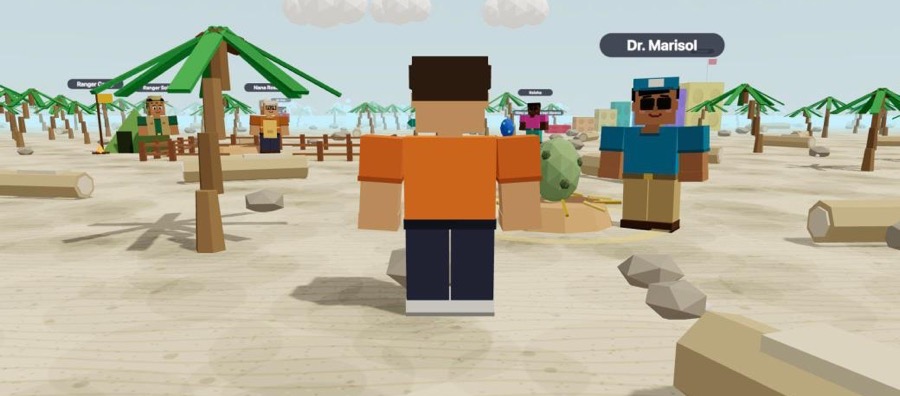
Snorkel a giant barrier reef, paddle through mangroves and explore ancient Maya cities in the rainforest. Characters here greet you with “Weh di go aan?” (hello in Belizean Kriol (it means “What’s going on?”)), and eggs hatch into hybrids of animals like West Indian manatee, green sea turtle, hawksbill sea turtle and whale shark.
What your child practices
Follows Geometry (6.G), plus circles and angles (Singapore P6).
Area of triangles
Find the area of a triangle with ½ × base × height, or work back to a missing height.
6.G.A.1
Area and perimeter of composite figures
Break shapes made of rectangles, triangles, semicircles and quarter circles into parts.
6.G.A.1
Area and circumference of circles
Use π × d and π × r × r for circles, semicircles and quarter circles.
7.G.B.4
Volume of cubes and cuboids
Find volume with fraction and decimal edges, work back to a missing size, and use √ and ∛.
6.G.A.2
Nets and surface area
Name the solid a net folds into, count its edges and corners, and add up its faces.
6.G.A.4
Polygons on the coordinate plane
Find side lengths, perimeters and areas of shapes from their corners on a grid.
6.G.A.3
Unknown angles in figures
Find missing angles in triangles, parallelograms, rhombuses, trapeziums and rectangles.
7.G.B.5
Try a problem from The Belize Barrier Reef
Every problem is a short story set in the world. These are real problems from the game. Kids get endless new ones with different numbers.
A fishing boat at Caye Caulker has a triangle-shaped sail.
Its base is 7.5 m, its slanted side is 13 m, and its height is 11 m.
What is the area of the sail?
Show the answer
41.25 m²
- The rectangle around it: 7.5 × 11 = 82.5 m².
- Half of it: 82.5 ÷ 2 = 41.25 m².
A pool for your manatee hatchling is a 13 m by 8 m rectangle with a semicircle on one 8 m end.
Use π = 3.14.
What is the area of the whole shape?
Show the answer
129.12 m²
- Rectangle: 13 × 8 = 104 m².
- Semicircle: ½ × 3.14 × 4 × 4 = 25.12 m².
- 104 + 25.12 = 129.12 m².
Your hatchling’s pen has a semicircle pond with a straight edge of 30 m.
Use π = 3.14.
What is the area of the semicircle?
Show the answer
353.25 m²
- The radius is 30 ÷ 2 = 15 m.
- Whole circle: 3.14 × 15 × 15 = 706.5 m².
- Half of it: 353.25 m².
Common mistakes, and how to help
Every wrong answer in Mixmonde is planned: it points to a named mistake, and the tip after a miss explains it with that problem’s numbers. These are the mistakes this world watches for, grouped the way the grown-ups’ dashboard shows them.
-
Units and measuring
The number is fine but the unit is off: a missing conversion (cm and m), the ruler not started at zero, or area mixed up with perimeter.
Mistakes we catch: forgot to halve, added the sizes instead of multiplying, used the slanted side as the height, forgot the cut-out part, mixed up area and perimeter, missed some sides, counted a line inside the shape, forgot the height, gave the volume, not the number of cubes, divided by the edge, not the cube’s volume, divided by one edge, found the volume, missed some faces and used only two sides.
Try at home: Before converting, ask whether the answer should be a bigger or smaller number. Fill a box with cubes to feel why volume uses cubic units.
-
Reading the question
The math works, but the answer is to a different question: a number already given, a halfway step, or only part of a two-step problem.
Mistakes we catch: left out a part.
Try at home: Underline what the question asks for and list the steps (“first find …, then …”). Tick each step off before giving the answer.
-
Shapes and angles
Shape properties: counting sides, corners or faces, symmetry, naming angles, measuring with a protractor or radius vs diameter.
Mistakes we catch: used the whole circle, used the diameter as the radius, mixed up radius and diameter, mixed up area and circumference, forgot to square the radius, forgot the straight edges, used half instead of a quarter, counted only one radius, mixed up prisms and pyramids, mixed up cubes and cuboids, named the wrong base shape, mixed up cones and cylinders, mixed up faces, edges and vertices, counted the flat net, used the wrong angle total, forgot the right angle, forgot the two equal angles, thought angles next to each other were equal and forgot opposite angles are equal.
Try at home: Unfold a cereal box to see its net. Measure angles with a protractor together, checking first whether the angle is smaller or bigger than a right angle.
-
Choosing the operation
The arithmetic is fine, but the wrong operation was picked: adding when the story takes away, or multiplying when it shares out.
Mistakes we catch: multiplied instead of divided.
Try at home: Have them say the plan in words first (“share 48 into groups of 6, so divide”). Swap in easy numbers to see which operation makes sense, then use the real ones.
-
Expressions and equations
Order of operations, unknowns and the equals sign: reading “=” as “the answer comes next” instead of “both sides balance”.
Mistakes we catch: divided instead of finding the root and mixed up √ and ∛.
Try at home: Write “mystery number” riddles for each other (“I double it and add 3, I get 17”). Solve by undoing the steps, last one first.
-
Negative numbers
Numbers below zero: comparing them (−5 is smaller than −2), counting across zero on a number line, and sign rules.
Mistakes we catch: added the coordinates and subtracted across zero.
Try at home: Track a bank balance or a temperature over a week with ups and downs, including below zero. Compare which day was coldest.
Ready to hatch the first egg? A grown-up creates the account in a minute, then it’s off to the first world. Kindergarten and Grade 1 are free. The other grades come with a membership.
Create a free accountMore Grade 6 worlds: Ratios, Rates & Percent · Fractions, Decimals & Factors · Negative Numbers & Coordinates · Expressions & Equations · Statistics