 Mixmonde
Play free
Lines, Angles & Shapes: 4th grade math in The Galápagos Islands
Parallel and perpendicular lines, angles and turns, compass directions, symmetry and tessellations.
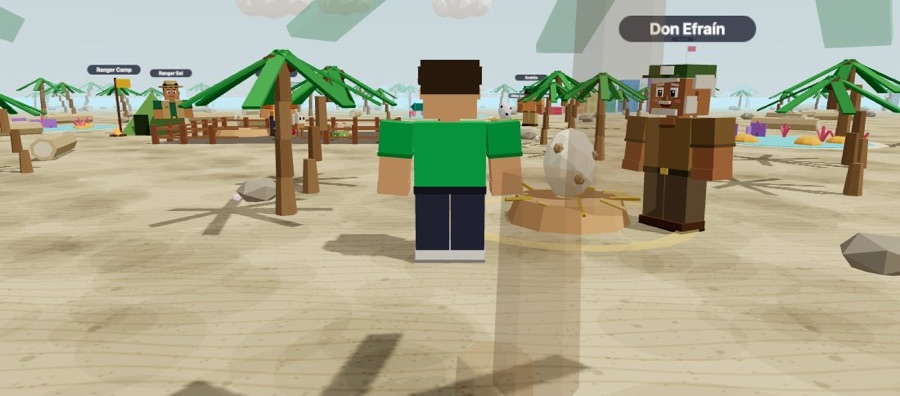
Sail between volcanic islands where giant tortoises, marine iguanas and blue-footed boobies live. Characters here greet you with “¡Hola!” (hello in Spanish), and eggs hatch into hybrids of animals like Galápagos giant tortoise, marine iguana, Galápagos land iguana and Galápagos sea lion.
What your child practices
Follows Geometry (4.G) and angle measurement (4.MD.C).
Lines, Rays and Segments
Name lines, rays and line segments, and spot parallel, perpendicular, horizontal and vertical lines.
4.G.A.1
Naming and Measuring Angles
Name angles like ∠ABC, estimate and measure them in degrees, and sort them as acute, right, obtuse or straight.
4.MD.C.5a, 4.MD.C.6, 4.G.A.1
Turns and Degrees
A 1/4 turn is 90°, a 1/2 turn is 180°, a 3/4 turn is 270° and a full turn is 360°.
4.MD.C.5a, 4.MD.C.5b
The 8-Point Compass
Find directions on an 8-point compass and turn clockwise or anticlockwise by 45°, 90° or 180°.
4.MD.C.5a
Finding Unknown Angles
Add and subtract angles to find a missing one, using the 90° corners of rectangles and squares.
4.MD.C.7
Rectangles and Squares
Use parallel sides, perpendicular sides and right angles to describe and sort rectangles and squares.
4.G.A.2
Line Symmetry
Find fold lines that make two matching halves, and count the lines of symmetry in a shape.
4.G.A.3
Tessellations
Find shapes that cover a floor with no gaps or overlaps, and the unit shape that repeats.
4.G.A.2
Try a problem from The Galápagos Islands
Every problem is a short story set in the world. These are real problems from the game. Kids get endless new ones with different numbers.
On the ranger’s map, a straight arrow starts at the dock, point F.
It passes the buoy at L and goes on forever in that direction.
Which name fits this figure best?
Show the answer
Ray
- Count the endpoints: a line has 0, a ray has 1 and a line segment has 2.
- It starts at F and goes on forever: 1 endpoint, so it is ray FL.
A park ranger ties a rope from post L to post Q, then on to post E.
The rope bends at one post and makes ∠LQE.
Which point is the vertex of ∠LQE?
Show the answer
Q
- In an angle name, the middle letter is the vertex.
- The middle letter of ∠LQE is Q.
You turn the dial on the incubator 90°.
It turns the same way the whole time.
What fraction of a full turn is that?
Show the answer
1/4
- A full turn is 360°.
- 90° out of 360° is 1 of the 4 quarter turns, so it is 1/4 of a turn.
Common mistakes, and how to help
Every wrong answer in Mixmonde is planned: it points to a named mistake, and the tip after a miss explains it with that problem’s numbers. These are the mistakes this world watches for, grouped the way the grown-ups’ dashboard shows them.
-
Shapes and angles
Shape properties: counting sides, corners or faces, symmetry, naming angles, measuring with a protractor or radius vs diameter.
Mistakes we catch: mixed up lines, rays and segments, mixed up parallel and perpendicular, thought any crossing lines are perpendicular, mixed up horizontal and vertical, read the wrong protractor scale, mixed up angle names, used the wrong letter for the vertex, thought longer arms make a bigger angle, did not compare with benchmark angles, used 180° for a full turn, used 100 for a full turn, counted only one of the turns, mixed up 45° and 90° steps, used the wrong whole angle, used the side next to it, not the opposite side, mixed up squares and rectangles, named a shape from one property, counted sides instead of pairs, mixed up parallel and perpendicular sides, thought any halving line is a line of symmetry, missed some lines of symmetry, mixed up turning with folding, only checked up-and-down folds, thought curved shapes tessellate, thought every regular shape tessellates, forgot tiles can be turned, mixed up the unit shape and forgot corners at a point make 360°.
Try at home: Fold paper shapes to find lines of symmetry. Use the corner of a sheet of paper as a right-angle checker around the house.
-
Counting and sequences
Losing track while counting: off by one, skipping or double-counting, or counting the wrong things (fence posts instead of gaps).
Mistakes we catch: counted only the short segments.
Try at home: Draw a number line and hop along it in 2s, 5s or 10s. For “posts and gaps” questions, sketch 3 posts and count the gaps before doing the big number.
-
Order and direction
The right idea done the wrong way round: taking the smaller digit from the bigger one, dividing backwards, swapping x and y, or flipping more and less.
Mistakes we catch: turned the wrong way, mixed up directions on a map and flipped only half of a direction.
Try at home: For subtraction, read the top number first every time (“52 take away 37”). For division, say “how many 4s fit in 20?” so the order is clear.
-
Choosing the operation
The arithmetic is fine, but the wrong operation was picked: adding when the story takes away, or multiplying when it shares out.
Mistakes we catch: added when you should subtract (or the other way).
Try at home: Read a word problem together and draw it as a quick picture or bar before choosing + − × ÷. Ask “is the answer bigger or smaller than the numbers we started with?”
-
Reading the question
The math works, but the answer is to a different question: a number already given, a halfway step, or only part of a two-step problem.
Mistakes we catch: left out one of the parts.
Try at home: Before solving, ask them to finish the sentence “The answer will be the number of …”. After solving, check that the answer fits that sentence.
Ready to hatch the first egg? A grown-up creates the account in a minute, then it’s off to the first world. Kindergarten and Grade 1 are free. The other grades come with a membership.
Create a free accountMore Grade 4 worlds: Big Numbers · Factors & Patterns · Fractions · Measurement & Data · Decimals