 Mixmonde
Play free
Fractions: 4th grade math in The Rainforests of Borneo
Equivalent fractions, mixed numbers, adding like fractions, and fractions of a set.
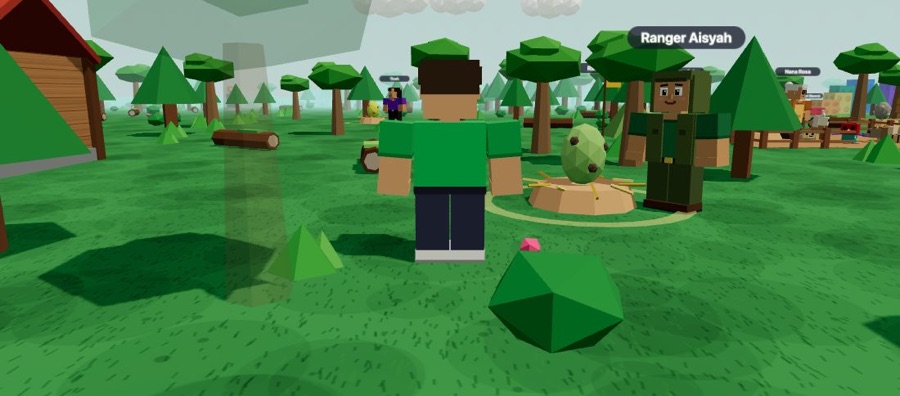
Glide through ancient treetops where orangutans nest and hornbills call. Characters here greet you with “Selamat datang!” (welcome in Malay), and eggs hatch into hybrids of animals like Sunda colugo, Wallace's flying frog, flying dragon lizard and paradise tree snake.
What your child practices
Follows Number & Operations — Fractions (4.NF).
Equivalent Fractions
2/3 of a sago cake is the same as 4/6 of it: multiply or divide the top and bottom by the same number.
4.NF.A.1
Comparing Fractions
Is 3/4 or 5/6 greater? Rename them to the same bottom number, or check them against 1/2.
4.NF.A.2
Mixed Numbers and Improper Fractions
11 quarter-logs of sago make 2 whole logs and 3/4 more: 11/4 = 2 3/4.
4.NF.B.3b, 4.NF.B.3c
Adding and Subtracting Like Fractions
When the bottom numbers match, add or subtract the tops: 3/8 + 4/8 = 7/8.
4.NF.B.3a, 4.NF.B.3d
Adding and Subtracting Related Fractions
Thirds and sixths are related: rename 1/3 as 2/6, then add 2/6 + 5/6.
5.NF.A.1
Adding and Subtracting Mixed Numbers
Add the wholes, add the fractions, and trade a whole for pieces when you need to.
4.NF.B.3c
Fraction of a Set
3/4 of 20 turtle eggs: split them into 4 equal groups of 5, then take 3 groups.
4.NF.B.4c
Fraction Times a Whole Number
5 hatchlings each eat 3/4 kg of figs: 5 × 3/4 = 15/4 = 3 3/4 kg.
4.NF.B.4a, 4.NF.B.4b, 4.NF.B.4c
Finding the Whole
If 3/5 of the eggs are 12 eggs, then 1/5 is 4 eggs, so all 5/5 are 20 eggs.
4.NF.B.4c
Try a problem from The Rainforests of Borneo
Every problem is a short story set in the world. These are real problems from the game. Kids get endless new ones with different numbers.
A sago pancake for your hatchlings is cut into 6 equal pieces, and they eat 3 pieces.
The next pancake is the same size but cut into 2 equal pieces.
How many of the 2 pieces make the same amount as 3/6?
Show the answer
1
- The bottom number goes from 6 to 2: 6 ÷ 3 = 2.
- Do the same to the top: 3 ÷ 3 = 1.
- So 3/6 = 1/2.
A rhinoceros hornbill flies 10/11 km to a fig tree.
Its mate flies 2/3 km to another fig tree.
Which distance is greater, in kilometers?
Show the answer
10/11
- Rename both with 33 as the bottom number.
- 10/11 = 30/33 and 2/3 = 22/33.
- 30 is more than 22, so 10/11 is greater.
A trail in Danum Valley has markers every 1/4 km.
A ranger walks past 15 markers.
How many kilometers is 15/4 km, as a mixed number in simplest form?
Show the answer
3 3/4
- 4 goes into 15 3 times, because 3 × 4 = 12.
- There are 3 left over, so 15/4 = 3 3/4.
Common mistakes, and how to help
Every wrong answer in Mixmonde is planned: it points to a named mistake, and the tip after a miss explains it with that problem’s numbers. These are the mistakes this world watches for, grouped the way the grown-ups’ dashboard shows them.
-
Fractions and decimals
Treating the top and bottom of a fraction as two separate whole numbers (so 1/2 + 1/3 = 2/5), thinking a bigger bottom number means a bigger piece, or reading 0.25 as bigger than 0.3.
Mistakes we catch: added or took away instead of multiplying or dividing, changed only one number, stopped before simplest form, thought a bigger bottom number means a bigger fraction, looked only at the top numbers, thought "one piece short" means equal, looked only at the size of the pieces, swapped the wholes and the leftover, put the leftover over the wrong number, left out the leftover pieces, added the whole number to the top, multiplied the wrong numbers, added the bottom numbers too, added or subtracted tops and bottoms, changed the bottom number but not the top, lost the extra whole, subtracted the smaller top from the bigger one, traded a whole for 10 pieces, found only one part, multiplied without dividing, multiplied the top and the bottom, multiplied the bottom number, dropped the bottom number, stopped at one part, forgot the known amount is several parts and took a fraction of the part.
Try at home: Use a chocolate bar or paper strips to compare fractions: is 1/3 or 1/5 bigger? Line up fraction strips to find equal ones (2/4 = 1/2).
-
Choosing the operation
The arithmetic is fine, but the wrong operation was picked: adding when the story takes away, or multiplying when it shares out.
Mistakes we catch: added when it should subtract (or the other way round) and added when it should subtract.
Try at home: Read a word problem together and draw it as a quick picture or bar before choosing + − × ÷. Ask “is the answer bigger or smaller than the numbers we started with?”
-
Reading the question
The math works, but the answer is to a different question: a number already given, a halfway step, or only part of a two-step problem.
Mistakes we catch: found the part used instead of the part left, found the other part of the set, stopped after the first step and found the whole instead of the rest.
Try at home: Before solving, ask them to finish the sentence “The answer will be the number of …”. After solving, check that the answer fits that sentence.
Ready to hatch the first egg? A grown-up creates the account in a minute, then it’s off to the first world. Kindergarten and Grade 1 are free. The other grades come with a membership.
Create a free accountMore Grade 4 worlds: Big Numbers · Factors & Patterns · Measurement & Data · Lines, Angles & Shapes · Decimals