 Mixmonde
Play free
Big Numbers: 4th grade math in The Australian Outback
Numbers up to 100,000, rounding, and multiplying and dividing multi-digit numbers.
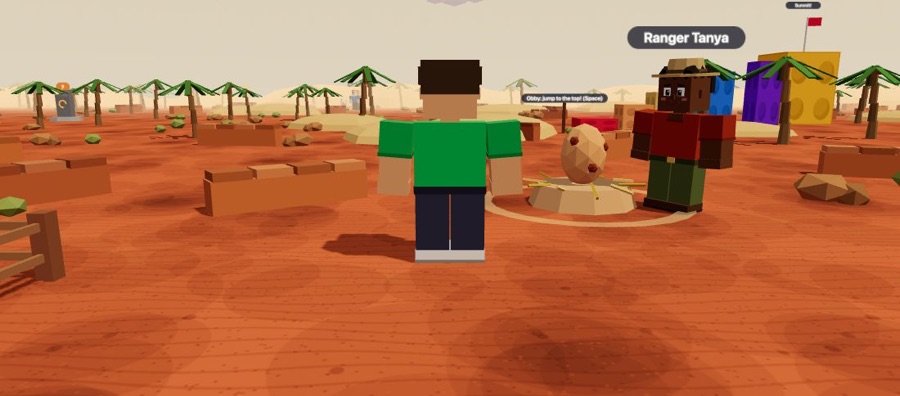
Hop across red sand, rocky gorges and shady billabongs under the biggest sky you have ever seen. Characters here greet you with “Palya!” (hello in Pitjantjatjara, spoken by Anangu around Uluru), and eggs hatch into hybrids of animals like red kangaroo, spinifex hopping mouse, thorny devil and short-beaked echidna.
What your child practices
Follows Number & Operations in Base Ten (4.NBT).
Big Numbers to 100,000
Read and write numbers to 100,000 and find what each digit is worth.
4.NBT.A.1, 4.NBT.A.2
Compare & Order
Find which big number is greater and put numbers in order.
4.NBT.A.2
Rounding
Round numbers to the nearest 10, 100 or 1000 and use ≈ for "is about".
4.NBT.A.3
Adding & Subtracting Big Numbers
Add and subtract big numbers, regrouping when you need to.
4.NBT.B.4
Multiplying by 1 Digit
Multiply numbers up to 4 digits by a 1-digit number.
4.NBT.B.5
Multiplying by 2 Digits
Multiply 2-digit and 3-digit numbers by a 2-digit number, row by row.
4.NBT.B.5, 5.NBT.B.5
Dividing by 1 Digit
Divide numbers up to 4 digits by a 1-digit number and decide what to do with leftovers.
4.NBT.B.6
Estimate & Check
Round to estimate answers, and use estimates to spot answers that make no sense.
4.NBT.A.3, 4.OA.A.3
Try a problem from The Australian Outback
Every problem is a short story set in the world. These are real problems from the game. Kids get endless new ones with different numbers.
Frank's windmills pumped thirty-four thousand, three liters of water for the cattle this week.
A galah grabs the pencil, so you write it in numerals.
How do you write that number in numerals?
Show the answer
34003
- Thirty-four thousand: write 34 in the thousands group.
- Three: the last group needs 3 digits, so write 003.
- Put the groups together: 34,003.
Three roadhouses sold this many pies: 7,008; 44,600; 44,299.
Miss Hannah asks the class to put them in order.
Which list goes from least to greatest?
Show the answer
7,008 → 44,299 → 44,600
- 7,008 has only 4 digits, so it is the least.
- 44,299 and 44,600 first differ in the hundreds place, so 44,299 is less.
- Least to greatest: 7,008 → 44,299 → 44,600.
Explorers in the outback have earned 91,967 Sparks so far.
For the report, a number that is close is good enough. The sign ≈ means "is about".
To the nearest ten, 91,967 ≈ what number?
Show the answer
91970
- 91,967 is between 91,960 and 91,970.
- Look at the digit after the tens place: 7. It is 5 or more, so round up.
- 91,967 ≈ 91,970.
Common mistakes, and how to help
Every wrong answer in Mixmonde is planned: it points to a named mistake, and the tip after a miss explains it with that problem’s numbers. These are the mistakes this world watches for, grouped the way the grown-ups’ dashboard shows them.
-
Place value
The digits are right but their places are not: a 3 in the tens is worth 30, not 3. This shows up when carrying, borrowing, lining up numbers or placing a decimal point.
Mistakes we catch: missing placeholder zeros, wrote each part separately, skipped a zero inside a group, digit instead of its value, miscounted places, compares first digits only, compares later digits, same digits means equal, always rounds down, rounded to the wrong place, rounded in steps, forgot to carry, lined up on the left, regrouped but kept the ten, forgot the placeholder zero, only used the ones digit, multiplied matching places only, missing zero in the answer and did not check the size.
Try at home: Write a number on paper with a column for thousands, hundreds, tens and ones. Take turns saying what each digit is worth, then add or subtract by trading between columns out loud ("ten ones make a ten").
-
Order and direction
The right idea done the wrong way round: taking the smaller digit from the bigger one, dividing backwards, swapping x and y, or flipping more and less.
Mistakes we catch: ordered the wrong way, symbol backwards and smaller from larger.
Try at home: For subtraction, read the top number first every time (“52 take away 37”). For division, say “how many 4s fit in 20?” so the order is clear.
-
Choosing the operation
The arithmetic is fine, but the wrong operation was picked: adding when the story takes away, or multiplying when it shares out.
Mistakes we catch: added instead of subtracted, added instead of multiplied and missed a wrong operation.
Try at home: Read a word problem together and draw it as a quick picture or bar before choosing + − × ÷. Ask “is the answer bigger or smaller than the numbers we started with?”
-
Number facts
The method is right, but a basic fact or one step of the arithmetic slipped. Usually a sign that facts are still being worked out each time instead of remembered.
Mistakes we catch: added the carry too soon.
Try at home: Pick one times table a week. Say it while walking or climbing stairs, then quiz in a random order. Link hard facts to easy ones: 7 × 8 is 7 × 4, doubled.
-
Reading the question
The math works, but the answer is to a different question: a number already given, a halfway step, or only part of a two-step problem.
Mistakes we catch: ignored the leftovers, counted a partial group, mixed up groups and leftovers, worked out the exact answer and skipped the check.
Try at home: Before solving, ask them to finish the sentence “The answer will be the number of …”. After solving, check that the answer fits that sentence.
Ready to hatch the first egg? A grown-up creates the account in a minute, then it’s off to the first world. Kindergarten and Grade 1 are free. The other grades come with a membership.
Create a free accountMore Grade 4 worlds: Factors & Patterns · Fractions · Measurement & Data · Lines, Angles & Shapes · Decimals