 Mixmonde
Play free
Time & Money: 3rd grade math in The Okavango Delta
Telling time to the minute, how long things take, start and end times, and adding and subtracting money.
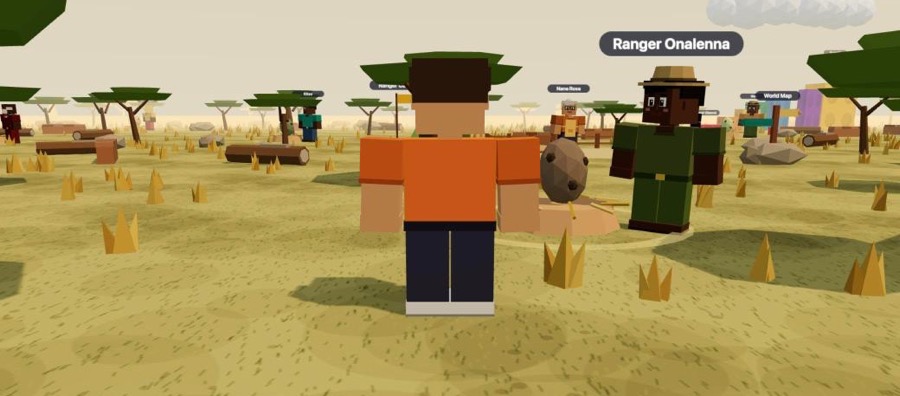
Pole a mokoro through a giant wetland where elephants wade and hippos snort. Characters here greet you with “Dumela!” (hello in Setswana), and eggs hatch into hybrids of animals like African elephant, hippopotamus, red lechwe and sitatunga.
What your child practices
Follows Measurement & Data — Time (3.MD.A.1), plus money (Singapore P3).
Telling time to the minute
Read the clock to the minute and say times with "past" and "to".
3.MD.A.1
Hours and minutes
Change hours and minutes to minutes, and minutes back to hours and minutes.
3.MD.A.1
How long did it take?
Find how many minutes pass from a start time to an end time.
3.MD.A.1
Start and end times
Find when something ends, or when it started, from how long it lasts.
3.MD.A.1
Time word problems
Add and take away times given in hours and minutes.
3.MD.A.1
Adding and subtracting money
Add and take away pula and thebe, trading 100 thebe for 1 pula.
4.MD.A.2
Money word problems
Solve shopping stories with pula and thebe at the Maun market.
4.MD.A.2
Try a problem from The Okavango Delta
Every problem is a short story set in the world. These are real problems from the game. Kids get endless new ones with different numbers.
Lesedi checks the clock on the lodge deck before the hatchlings eat.
The short hand is about halfway between the 2 and the 3.
The long hand is 2 small marks past the 4.
What time does the clock show?
Show the answer
2:22
- The short hand is about halfway between the 2 and the 3, so the hour is 2.
- The long hand: 4 × 5 = 20 minutes, plus 2 more is 22 minutes.
- The time is 2:22.
The egg stays warm in the incubator for 2 hours 25 minutes.
How many minutes is that?
Show the answer
145 minutes
- 2 hours = 2 × 60 = 120 minutes.
- 120 + 25 = 145 minutes.
The explorers start a walk to the hippo pool at 7:38.
They reach it at 8:29.
How many minutes long was the walk?
Show the answer
51 minutes
- From 7:38 to 8:00 is 22 minutes.
- From 8:00 to 8:29 is 29 minutes.
- Altogether: 51 minutes.
Common mistakes, and how to help
Every wrong answer in Mixmonde is planned: it points to a named mistake, and the tip after a miss explains it with that problem’s numbers. These are the mistakes this world watches for, grouped the way the grown-ups’ dashboard shows them.
-
Time and money
Reading the clock or counting money: hour and minute hands mixed up, treating an hour as 100 minutes, or coin values.
Mistakes we catch: read the next hour, read the number as minutes, mixed up the hands, mixed up past and to, used the wrong hour with "to", counted 100 minutes in an hour, left out the extra minutes, took away only one hour, subtracted times like plain numbers, counted only the hours, stopped at the next hour and forgot to cross the hour.
Try at home: Plan a day out: how long from 10:45 to 1:15? Count on to the next hour first. Let them pay and count the change at a shop.
-
Order and direction
The right idea done the wrong way round: taking the smaller digit from the bigger one, dividing backwards, swapping x and y, or flipping more and less.
Mistakes we catch: counted the wrong way and took the smaller from the larger.
Try at home: For subtraction, read the top number first every time (“52 take away 37”). For division, say “how many 4s fit in 20?” so the order is clear.
-
Reading the question
The math works, but the answer is to a different question: a number already given, a halfway step, or only part of a two-step problem.
Mistakes we catch: missed a part and forgot a step.
Try at home: Before solving, ask them to finish the sentence “The answer will be the number of …”. After solving, check that the answer fits that sentence.
-
Choosing the operation
The arithmetic is fine, but the wrong operation was picked: adding when the story takes away, or multiplying when it shares out.
Mistakes we catch: wrong operation.
Try at home: Read a word problem together and draw it as a quick picture or bar before choosing + − × ÷. Ask “is the answer bigger or smaller than the numbers we started with?”
-
Place value
The digits are right but their places are not: a 3 in the tens is worth 30, not 3. This shows up when carrying, borrowing, lining up numbers or placing a decimal point.
Mistakes we catch: forgot to trade 100 thebe, lined up pula and thebe wrongly and forgot to trade a pula.
Try at home: Write a number on paper with a column for thousands, hundreds, tens and ones. Take turns saying what each digit is worth, then add or subtract by trading between columns out loud ("ten ones make a ten").
Ready to hatch the first egg? A grown-up creates the account in a minute, then it’s off to the first world. Kindergarten and Grade 1 are free. The other grades come with a membership.
Create a free accountMore Grade 3 worlds: Numbers to 10,000 · Multiplication & Division · Fractions · Area, Perimeter & Shapes · Measuring & Graphs