 Mixmonde
Play free
Measuring & Graphs: 3rd grade math in Hawaiʻi
Length, mass and liquid volume in metric units, converting units, and bar graphs and line plots.
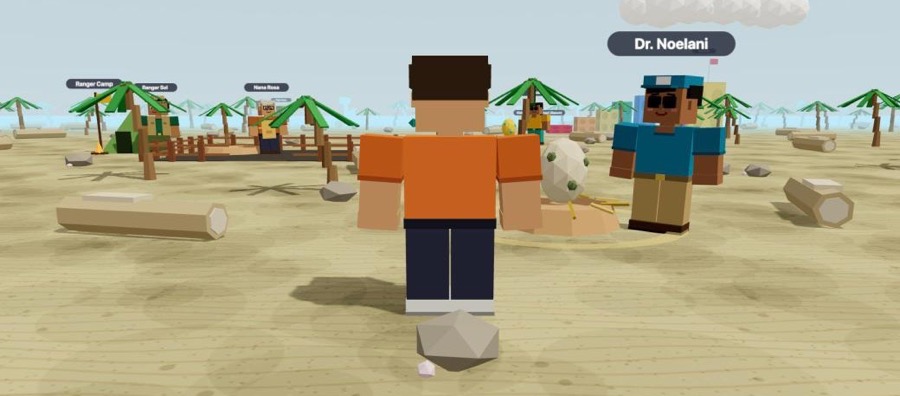
Paddle past volcanoes and coral reefs where honu rest on the sand and humpback whales sing. Characters here greet you with “Aloha!” (hello in ʻōlelo Hawaiʻi (it also means love and kindness)), and eggs hatch into hybrids of animals like honu (green sea turtle), Hawaiian monk seal, humpback whale and spinner dolphin.
What your child practices
Follows Measurement & Data — Measurement and Data (3.MD.A.2, 3.MD.B).
Kilometers, meters and centimeters
Change km to m and m to cm, and back, to compare lengths.
4.MD.A.1
Grams and kilograms
Read a scale and change kilograms to grams and back.
3.MD.A.2, 4.MD.A.1
Liters and milliliters
Read a measuring jug and change liters to milliliters and back.
3.MD.A.2
Mixed units (like 2 m 35 cm)
Change mixed units like 2 m 35 cm into one unit, and split a measure into two units.
4.MD.A.2
Measurement word problems
Add, take away, multiply and share masses and liquid volumes.
3.MD.A.2
Reading bar graphs
Read the scale of a bar graph and answer "how many more" and "how many in all".
3.MD.B.3
Completing a bar graph
Work out how tall a missing bar should be from the data.
3.MD.B.3
Line plots with halves and quarters
Read line plots of lengths measured to the nearest half or quarter centimeter.
3.MD.B.4
Try a problem from Hawaiʻi
Every problem is a short story set in the world. These are real problems from the game. Kids get endless new ones with different numbers.
The outrigger canoe team paddled 7 km along the coast of Oʻahu this morning.
How many meters is that?
Show the answer
7000 m
- 1 km = 1,000 m.
- Bigger unit to smaller unit: multiply.
- 7 × 1,000 = 7,000 m.
A bag of food for the nēnē geese at the farm weighs 5,000 g.
How many kilograms is that?
Show the answer
5 kg
- 1 kg = 1,000 g.
- Smaller unit to bigger unit: divide.
- 5,000 ÷ 1,000 = 5 kg.
You pour water into a measuring jug for the nēnē goslings.
The marks go up by 100 mL. The pointer is 3 marks past the 300 mL line.
How many milliliters of water are in the jug?
Show the answer
600 mL
- Each mark is 100 mL: 3 × 100 = 300 mL.
- Start at 300: 300 + 300 = 600 mL.
Common mistakes, and how to help
Every wrong answer in Mixmonde is planned: it points to a named mistake, and the tip after a miss explains it with that problem’s numbers. These are the mistakes this world watches for, grouped the way the grown-ups’ dashboard shows them.
-
Units and measuring
The number is fine but the unit is off: a missing conversion (cm and m), the ruler not started at zero, or area mixed up with perimeter.
Mistakes we catch: wrong conversion number, multiplied instead of divided, compared the numbers, not the lengths, counted each mark as 1, joined the numbers, left out the extra part, gave the other part and added different units.
Try at home: Measure the same table in cm and in m. Walk around a rug for perimeter, then cover it with sheets of paper for area.
-
Counting and sequences
Losing track while counting: off by one, skipping or double-counting, or counting the wrong things (fence posts instead of gaps).
Mistakes we catch: forgot where the marks start.
Try at home: Draw a number line and hop along it in 2s, 5s or 10s. For “posts and gaps” questions, sketch 3 posts and count the gaps before doing the big number.
-
Choosing the operation
The arithmetic is fine, but the wrong operation was picked: adding when the story takes away, or multiplying when it shares out.
Mistakes we catch: added instead of subtracted (or the other way), added instead of multiplied and multiplied instead of divided.
Try at home: Read a word problem together and draw it as a quick picture or bar before choosing + − × ÷. Ask “is the answer bigger or smaller than the numbers we started with?”
-
Graphs and data
Reading graphs: missing that one picture stands for several, misreading the scale, or mixing up mean, median and range.
Mistakes we catch: counted each line as 1, read the line below, used the number, not the lines, multiplied by the scale, counted the lengths, not the dots, counted the boundary, counted the jumps as whole units and picked the biggest length.
Try at home: Draw a bar graph of something you track (weather, pets seen on a walk) with a scale counting in 2s or 5s.
-
Reading the question
The math works, but the answer is to a different question: a number already given, a halfway step, or only part of a two-step problem.
Mistakes we catch: forgot a bar.
Try at home: Before solving, ask them to finish the sentence “The answer will be the number of …”. After solving, check that the answer fits that sentence.
Ready to hatch the first egg? A grown-up creates the account in a minute, then it’s off to the first world. Kindergarten and Grade 1 are free. The other grades come with a membership.
Create a free accountMore Grade 3 worlds: Numbers to 10,000 · Multiplication & Division · Fractions · Area, Perimeter & Shapes · Time & Money