 Mixmonde
Play free
Time, Money & Shapes: 2nd grade math in The Zambezi and Victoria Falls
Time to 5 minutes, a.m. and p.m., dollars and cents, money story problems, and flat and solid shapes.
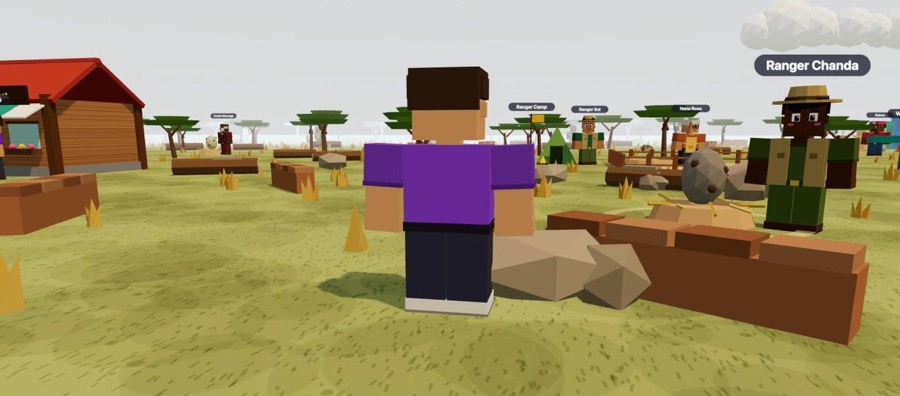
Walk through the misty rain forest by a roaring waterfall, and float down a mighty river full of hippos. Characters here greet you with “Muli bwanji?” (hello, how are you? in Nyanja, spoken in Zambia), and eggs hatch into hybrids of animals like African elephant, hippopotamus, Nile crocodile and Nile monitor.
What your child practices
Follows Measurement & Data — Time and Money (2.MD.C) and Geometry (2.G.A.1).
Time to 5 minutes
Read the clock to 5 minutes, and know that h means hours and min means minutes.
2.MD.C.7
a.m. and p.m.
Use a.m. for morning times and p.m. for afternoon and evening times.
2.MD.C.7
Half an hour and an hour later
Find the time half an hour or 1 hour later, and know an hour is 60 minutes.
2.MD.C.7
Dollars and cents
Count coins and bills, write money like $3.45, and change dollars to cents and back.
2.MD.C.8
Comparing amounts of money
Compare two or three amounts of money: dollars first, then cents.
2.MD.C.8
Money story problems
Solve market stories with dollars only or cents only: totals, change and money left.
2.MD.C.8
Flat shapes and their parts
Name semicircles, quarter circles and shapes by their sides, and find the shapes that make a figure.
2.G.A.1
Solid shapes
Name and describe cubes, cuboids, cones, cylinders and spheres by their faces, corners and curved surfaces.
2.G.A.1
Try a problem from The Zambezi and Victoria Falls
Every problem is a short story set in the world. These are real problems from the game. Kids get endless new ones with different numbers.
Tendai looks at the clock in the hut near the falls.
The short hand is between the 2 and the 3.
The long hand points to the 4.
What time does the clock show?
Show the answer
2:20
- The short hand is between the 2 and the 3, so the hour is 2.
- The long hand is on the 4. Count by 5s: 5, 10, 15, 20. That is 20 minutes.
- The time is 2:20.
Nana Rosa gives the hatchlings their breakfast.
Namakau looks at the clock. It shows 7:15.
Is it 7:15 a.m. or 7:15 p.m.?
Show the answer
7:15 a.m.
- a.m. is for times from midnight to noon: night and morning. p.m. is for times from noon to midnight: afternoon and evening.
- It is morning, so it is 7:15 a.m..
The hatchling falls asleep at 10:55.
It sleeps for half an hour.
What time does it wake up?
Show the answer
11:25
- Half an hour is 30 minutes.
- 55 + 30 = 85 minutes. That is 1 hour and 25 minutes.
- So it is 11:25.
Common mistakes, and how to help
Every wrong answer in Mixmonde is planned: it points to a named mistake, and the tip after a miss explains it with that problem’s numbers. These are the mistakes this world watches for, grouped the way the grown-ups’ dashboard shows them.
-
Time and money
Reading the clock or counting money: hour and minute hands mixed up, treating an hour as 100 minutes, or coin values.
Mistakes we catch: read the next hour, read the number as minutes, mixed up the hands, counted by 10s, mixed up h and min, mixed up a.m. and p.m., counted the wrong way from noon, mixed up an hour and half an hour, thought half an hour is 50 minutes, forgot to cross the hour, counted 100 minutes in an hour, counted the coins, mixed up dimes and nickels, left out the dot, swapped dollars and cents, forgot the dollars, read cents as dollars, compared the cents first, ignored the cents and compared cents with dollars.
Try at home: Read a real clock at meals and bedtime (“the short hand is on 7”). Sort and count real coins by value, not by how many.
-
Order and direction
The right idea done the wrong way round: taking the smaller digit from the bigger one, dividing backwards, swapping x and y, or flipping more and less.
Mistakes we catch: counted back and took the smaller digit from the larger.
Try at home: Use “more” and “fewer” in everyday talk: which plate has more grapes, how many fewer? Line things up side by side to compare.
-
Place value
The digits are right but their places are not: a 3 in the tens is worth 30, not 3. This shows up when carrying, borrowing, lining up numbers or placing a decimal point.
Mistakes we catch: wrote a few cents as tens of cents, put the dot in the wrong place and forgot to regroup.
Try at home: Make bundles of 10 with straws or pencils and a rubber band. Build numbers like 34 (3 bundles, 4 loose) and swap a bundle for 10 loose ones when you need to take some away.
-
Reading the question
The math works, but the answer is to a different question: a number already given, a halfway step, or only part of a two-step problem.
Mistakes we catch: mixed up more and less and forgot a step.
Try at home: Read the question aloud together and ask “what are we trying to find?” before solving. Point at the question part of the sentence.
-
Choosing the operation
The arithmetic is fine, but the wrong operation was picked: adding when the story takes away, or multiplying when it shares out.
Mistakes we catch: wrong operation.
Try at home: Act out word problems with toys: “3 birds, 2 fly away.” Ask “are we putting together or taking away?” before any numbers.
-
Shapes and angles
Shape properties: counting sides, corners or faces, symmetry, naming angles, measuring with a protractor or radius vs diameter.
Mistakes we catch: mixed up semicircle and quarter circle, named the whole circle, ignored the curved side, counted the curved side as straight, miscounted the sides, named one piece, not the whole, mixed up cube and cuboid, mixed up cone and cylinder, named a flat shape, counted only the faces in front, counted the corners of one face, counted a curved surface as flat and mixed up rolling and stacking.
Try at home: Go on a shape hunt at home and count sides and corners. Build shapes with sticks or straws.
Ready to hatch the first egg? A grown-up creates the account in a minute, then it’s off to the first world. Kindergarten and Grade 1 are free. The other grades come with a membership.
Create a free accountMore Grade 2 worlds: Numbers to 1,000 · Adding & Subtracting to 1,000 · Multiplication & Division · Fractions · Measuring & Graphs